I’m putting the finishing touches on republishing the third book of the Ridgewood Chronicles. An acclaimed author told me that the more we know about writing, the harder it is to let go of our stories. We’ll always find something wrong with them in the reread. The trick is knowing when to let go. I think I know it’s time to let go and publish the book.
Meanwhile, I’d like to share a story I wrote a few months ago. My last story share was in October of 2024, so posting another one is well overdue. Besides, I promised to post more often on my blog, so this is a good start for 2026.
The piece is a little wordy—I haven’t edited it yet. It’s a bit tongue-in-cheek with some eerie events sprinkled in. Enjoy.
* * *
“You think I wrote that book because I wanted to?” I said, swirling the apple juice in my glass a little too hard. The ice clinked like loose teeth. My editor, Mark, leaned back in his chair, eyebrows raised. He’d asked a simple question: “Why Hadestown?” And now here we were, knee-deep in something heavier than he’d bargained for.
The truth was, I hadn’t planned on writing a novel about a failing musician who sells his soul to play the perfect gig. Not consciously, anyway. It started with a dream—one of those 3 AM fever visions where the details stick like tar. I woke up with my hands shaking, humming a melody I’d never heard before. By noon, I’d scribbled twelve pages in a diner booth, ink smudged with pancake syrup. The waitress kept refilling my coffee like she knew I wasn’t leaving until it was done.
Mark tapped his pen against his notepad, the sound sharp as a metronome. “So it wasn’t about the advance?” he asked, half-joking. I laughed, but it came out jagged. The advance was gone before the manuscript hit his desk—vanished into hospital bills and the kind of debt that follows you like a stray dog. Hadestown wasn’t a choice. It was the only thing left when the rest of me burned out. The songs in the book? Those were real. I’d played them in dive bars where the mic shocked my lips if I stood too close.
The diner became my second apartment. The waitress—her name was Rosa—started leaving a slice of cherry pie on my table without asking. She’d hum along to the tunes I muttered under my breath while writing. One night, she slid into the booth across from me and said, “You know, my brother played bass in a band that toured with The Strokes once.” Her voice was casual, but her eyes were sharp. “He died last year. Overdose.” I didn’t know what to say, so I pushed the pie toward her. She took a bite and nodded at my notebook. “Keep going.”
The manuscript grew like a scar. Every chapter was another layer of skin grafted over the raw parts. The protagonist’s descent into Hadestown wasn’t just a metaphor, it was the exact shape of the hole in my chest after the divorce. The devil in the story? She had my ex-wife’s laugh, the way it used to cut through a crowded room like a scythe. Mark would’ve called that “too on the nose,” but fiction isn’t therapy. It’s bloodletting.
Rosa’s brother’s name was Javier. I never met him, but his ghost started showing up in the margins. He became the trumpet player in the book’s house band, fingers permanently stained with resin. Some nights, I’d catch Rosa wiping down the counter with a fury that suggested the grease stains were personal. Once, she snapped a towel at a trucker who asked why a pretty thing like her was “wasting time” in a diner. The crack of the cloth sounded like a snare drum. I wrote that moment into chapter seven.
Mark cleared his throat, pulling me back to the present. “You realize this is the part where most authors say they ‘found healing’?” He smirked, but his fingers were tight around his glass. The lie in that sentiment was almost funny. Healing implies an end, but writing Hadestown was more like learning to walk with a limp. You don’t fix the damage, you just stop noticing it with every step.
The book didn’t save me. It just gave the chaos a shape. When the galleys arrived, I read the last page and threw up in the sink. Not from pride. From recognition. The final scene of the musician stumbling out of Hadestown, hollowed out but still humming, wasn’t fiction. It was the Tuesday after the divorce papers came, when I stood in the Walmart parking lot at 2 AM, screaming along to a song only I could hear. Some kid taking out the trash stared at me like I was rabid. I probably was.
Mark spun his glass between his palms. “What now?” he asked. The unspoken question hung thicker: Was it worth it? Outside, a neon sign flickered, casting his face in bruised light. I thought about the diner’s jukebox, how Rosa let me queue the same Tom Waits song six times in a row until the other customers groaned. How the protagonist’s final solo was lifted note-for-note from the voicemail my ex left me, her voice slurred with champagne and spite. Art isn’t alchemy. It’s grave robbery. You dig up what’s rotting and call it a monument.
“Now?” I swallowed the last of my juice, felt it burn a cold path to my gut. “Now I write the next one.”
Mark’s laugh was startled, almost nervous. “Already?”
Hadestown had barely hit the shelves, but my fingers itched like they’d caught a rhythm. The dreams hadn’t stopped, just changed. Last week, I woke up with a name in my mouth: Lila. No face, no story, just the weight of it, like a stone in my pocket. That’s how it starts. A whisper. A reckoning.
The morning following my meeting with Mark, I sat in my booth and wrote—pen to paper, old fashioned and quicker than typing.
Rosa claimed dibs on reading it when I got stuck. “Bring it here,” she said one morning, slinging a rag over her shoulder. “I’ll tell you if it’s working.” When I returned from the public toilet, I found a sticky note on the cover page: Javier would’ve hated it. Too many metaphors. Keep writing.
Mark thought the book should be about success. “Readers eat that up—the redemption arc,” he said at our next meeting, tapping his Montblanc against the contract. But success smelled like bleach and stale coffee to me. The real story was in the cracks, the unscrubbed corners. Lila started appearing in dreams with a switchblade smile, carving her name into the vinyl booths of the diners in her world. I woke up with my hands smelling of coffee and bacon.
The diner’s jukebox broke a week later. Rosa pried it open with a butter knife, her elbows deep in wires. “Piece of junk,” she muttered, but I saw her wipe her eyes with the back of her wrist. Javier had put a quarter in that machine the night he left for the tour. It played “Heart of Gold.” It played again when she fixed it. It played in my mind when I wrote that into the new outline of Lila’s first appearance, all ripped fishnets and a voice like broken glass in a diner with a dying jukebox.
Mark called it “too niche.” I hung up and shoved my phone in my back pocket. I cracked the screen in a spiderweb pattern when I sat, just like the one Lila would press her palm against in chapter three, whispering, See how it holds, even when it’s broken?
I started stealing again. Not money—sounds. The hiss of the diner’s coffee machine became Lila’s exhale before a fight. The screech of bus brakes? That was her laughter, sharp enough to draw blood. Rosa caught me recording the clatter of her dish rack one morning. She didn’t say a word, just slid a plate of eggs toward me with a Post-it stuck to the side: You owe me royalties.
Mark hated the new pages. “The protagonist’s a con artist who steals voices?” He rubbed his temple like I’d given him a migraine. “It’s not marketable.” I wanted to tell him Lila wasn’t a character—she was the static in my veins when I forgot my meds, the way my ex’s perfume clung to my jackets long after she’d left. Instead, I took the check he offered and bought a vintage tape recorder from a pawnshop that smelled of mildew and menthol.
The diner’s freezer broke the next day. Rosa cursed as she hauled soggy boxes of patties into the alley. I sat on the dumpster lid, recording the gulls fighting over spoiled beef. One bird had a mangled foot; it limped in circles, screeching.
“That’s your opening line,” Rosa said, lighting a cigarette with hands still flecked with frost. She exhaled smoke through her nose. “Something hungry. Something wounded.”
I played the tape back later. Beneath the gulls’ cries, you could hear the wet thud of meat hitting pavement—Lila’s heartbeat.
Mark emailed about “brand consistency.” I replied with a photo of the freezer’s corpse, its rusted hinges gaping like a mouth. He didn’t get it. Hadestown sold because it bled. Readers licked their fingers and turned pages like they were tasting the wound. Lila wouldn’t be clean. She’d smell of motor oil and Budweiser, her knuckles split from punching dashboard radios when the songs got too real. I told Rosa this while she mopped melted ice cream off the tiles. She nodded toward the tape recorder. “So put that in.”
The pawnshop tape deck had a quirk: it recorded ghosts. Not literal ones (probably), but the echoes of whatever had been taped over. Between Lila’s stolen monologues, you could hear a child singing “Happy Birthday” in Spanish, the warble of a 1988 weather report. Javier’s voice surfaced at 3:17 AM. Just two words: Mierda, Rosa, before cutting to static. I played it for her at the counter. Her hands froze around the handle of a coffee pot. “That’s him,” she said. Not surprised. Like she’d been waiting. The pot cracked against the burner.
I tried to apologize. Rosa grabbed my collar and kissed me hard enough to split my lip. “Shut up,” she muttered, tasting of nicotine and cherry pie. “You don’t get to be sorry for what’s real.” The tape kept running. It caught the sound of her belt buckle hitting the floor, the groan of the booth under our weight. Later, editing the audio, I’d notice how our breathing synced with the freezer’s dying hum. Lila’s first chapter wrote itself that night—half erotica, half autopsy.
Mark called it “commercial suicide.” He wanted another Hadestown: tragic boys with guitars, devils in designer heels. But Lila wasn’t some metaphor. She was the rust under Rosa’s nails when she dug them into my back. She was Javier’s unfinished riff still echoing in the diner’s vents. When I handed Rosa chapter five where Lila pistol-whips a talent scout with his own Grammy, she laughed so hard she snorted coffee.
“Finally,” she said, slamming the mug down. “Someone who gets it.”
That was Thursday. On Friday, Rosa didn’t show for her shift. The diner owner called her apartment, a few friends, the hospitals while I paced the parking lot, replaying her last words to me: Don’t romanticize this. The cops found her sneaker first—neon pink, the kind nurses wear—twenty feet from the impact. The truck driver swore he didn’t see her crossing. The EMTs pronounced her dead at the scene. The coroner’s report would later note she had cherry pie in her stomach.
I stopped writing. Not dramatically—no grand bonfire of manuscripts—just a slow withdrawal. The diner wasn’t the same, like it had lost its heart, its soul. The new waitress, a college kid with a nose ring, kept refilling my coffee out of habit until she stopped coming over altogether. Mark left increasingly desperate voicemails about deadlines. I erased them. Rosa’s ghost didn’t appear right away. She waited until I was drunk enough to see double, slumped in our booth with my forehead against the sticky vinyl. Then—tap tap—her wedding ring against a coffee cup.
“You’re being an idiot,” she said. Her voice wasn’t ethereal. It had the same fry from yelling over the grill. I didn’t look up. “You think Javier got a choice?” she continued. The ice in her water glass hadn’t melted. “Quit mourning and write the book.”
The new waitress quit, and the new hire—Lila, of all names—dropped a plate in the kitchen on her first day. The sound was a gunshot. Rosa’s ghost flinched. I hadn’t known ghosts could do that. “She’s got my brother’s hands,” Rosa muttered.
Lila’s fingers were stained with Sharpie where she’d drawn roses on napkins. When she slid my coffee across the counter, her sleeve hitched up—a tattoo of a cat eating its own tail. I grabbed her wrist before I could stop myself. “Why’d you get a tattoo like that?” My voice cracked like the diner’s vinyl booths. She didn’t pull away. “Same reason you write about devils,” she said. Her pulse jumped under my thumb. “To see if it hurts.”
Rosa’s ghost had been right. Lila wasn’t just a waitress—she was the serrated edge the story needed. She smelled like my lawn after a summer rain, and talked in half-finished sentences that hung in the air like smoke. I caught her stealing silverware, slipping forks into her boots like they were contraband. “For protection,” she explained when I raised an eyebrow. Her smile was all teeth. “Ever stabbed a man with a spoon?” She shook her head.
I slid the manuscript across the counter one night. “It’s not about you, but I could use an honest opinion.”
She didn’t touch it at first, just stared at the title page—LILA EATS THE WORLD—like it was a warrant for her arrest. Then she flipped to chapter twelve, where the protagonist jams a harmonica into her boyfriend’s mouth. Her fingers traced the ink like she was reading braille. “I think you got her laugh wrong,” she said finally. “It should sound more like a dying lawnmower.” She demonstrated. The sound scraped my eardrums raw. I rewrote the line on a napkin.
A week later, she read the whole thing in one sitting, legs swinging under the counter like a kid on a stool. When she reached the end where Lila’s stand-in lights a casino on fire with a tampon soaked in vodka, she slapped the pages down so hard my coffee jumped. “Marry me,” she said. Not a question. A demand. Her pupils were swallowing the green.
I choked on my own coffee. “That’s your takeaway?”
She leaned in close enough that I could count the freckles dusting her nose. “It’s what Rosa wants,” she whispered. Her breath smelled of stolen mints and something metallic.
The diner’s AC kicked on, sending a shudder through the overhead lamps. For a second, I swore I saw Rosa’s reflection in the chrome napkin dispenser—just the curve of her smirk before it warped back into my own exhaustion.
Then the freezer sang a low, thrumming vibration that made my molars ache. The melody from my dream that started all this seeped through the kitchen door like gas. Lila’s fingers dug into my forearm. “You hear that?” Her voice was barely audible over the hum. The freezer’s light had burned out months ago, but now a sickly green glow pulsed through the crack in the door. I stood on legs that didn’t feel like mine.
The door swung open before I touched it. Cold mist rolled over my shoes, smelling of sugar and copper. Inside, the wire shelves sagged under rows of cherry pies, their crimped crusts gleaming with condensation. Every single slice had a piece taken—not haphazard, but precise. The missing arcs formed a grinning mouth, the edges stained red where the filling had bled.
Lila exhaled sharply; her breath fogged in the air. The melody swelled, resolving into a tune I hadn’t played since Rosa’s funeral: Heart of Gold, but warped, the notes stretched like taffy.
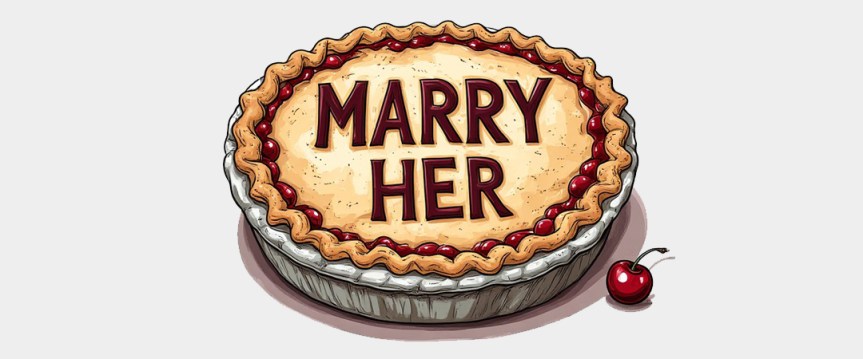
The third pie from the left was still warm. Steam curled from the gash where someone—or something—had carved two words into the filling with a knife: MARRY HER. The letters oozed syrup onto the aluminum tray.
Lila reached past me, dragging her fingertip through the mess. She licked it clean without breaking eye contact. “Tastes like she means it,” she said. The light flickered, casting her face in jagged shadows. Behind her, the jukebox sputtered to life, belting out a crackling version of Here Comes the Bride.
Rosa’s whisper came from everywhere at once—the drip of the coffee machine, the rattle of the ice machine, the creak of the corrugated floor as I shifted my weight. “Be happy. You deserve it.” The words weren’t sweet. They were an order, the kind she used to bark when I tried to skip meals to keep writing.
Lila’s knee knocked against mine. “She’s bossy for a dead chick,” she muttered. “We should do what she says.”
The freezer’s glow pulsed brighter, illuminating the dust motes between us like suspended glitter.
The book hit #1 the same day we got married in the diner’s parking lot at 4:37 AM under a flickering streetlight. The officiant was an Elvis impersonator Rosa used to flirt with on graveyard shifts. He smelled like bourbon and hairspray, but his hands were steady when he tied the knot around our wrists with a dishrag.
Lila burned her apron in the parking lot. When the flames died and left charred polyester behind, we watched the smoke from our booth, her head on my shoulder, my fingers sticky with cherry filling. The NYT notification popped up on my cracked phone screen. Lila snorted. “Told you they’d like it.” Her wedding ring—a bent fork tine she’d hammered into shape—dug into my palm when I squeezed her hand. The diner’s new hire, some kid with a lip ring and an apparent death wish tattooed on his forehead, brought us champagne in coffee mugs. It tasted like battery acid and victory.
Mark called forty-seven times before I picked up.
“It’s grotesque,” he hissed, but I could hear the champagne cork popping in the background. “Readers are calling it ‘transgressive.’”
Lila stole the phone. “Tell ’em transgressive is just a fancy word for alive,” she purred before hanging up. The freezer light flickered in agreement.
Then we toasted to grotesque. To transgressive. To the pie stain on my wedding shirt that looked like a Rorschach test of Rosa’s smirk.
* * *
As always, thanks for reading my blog. Peace and love.
Steve, 1/23/2026
This post “Story Time: ‘Rosa, Lila, and Cherry Pies’” copyright © 2026 Steven Leo Campbell at stevecampbellcreations.com – All rights reserved.
 Steve Campbell Creations
I make comments as I read. Lines I particularly like. For example, “Mark would’ve called that “too on the nose,” but fiction isn’t therapy. It’s bloodletting.” Yes, it is self-serving and dramatic. But that’s the tone you seem to be going for all the way through. You have made Rosa as interesting as the first person author, and I’m only starting.
In other words, THANKS. I’m having a good time reading this.
LikeLiked by 1 person
Thanks, purplegoatee, glad you’re enjoying this.
LikeLike
Healing implies an end, but writing Hadestown was more like learning to walk with a limp. You don’t fix the damage, you just stop noticing it with every step.
Okay. Why are you feeling so sorry for yourself? At least, that’s the way this feels….
I have read it. It is powerful. I shall read more. One thing I am curious about is the persona you write of. Morbidly full of yourself. Or should I say full of itself. That is the heart of my curiosity.
LikeLiked by 1 person
The main character is based on some authors I know. Some are full of self-importance; some aren’t. Some just write to find themselves in the characters they create. Others hide behind humor and absurdity. My character is a conglomeration of all the above.
LikeLike