Hi everyone. I’m back at the computer after taking a week off. I hope all my United States readers and followers had a great Fourth of July.
This repost features the evolution of a black bear I painted in acrylic on canvas in 1989. Enjoy.
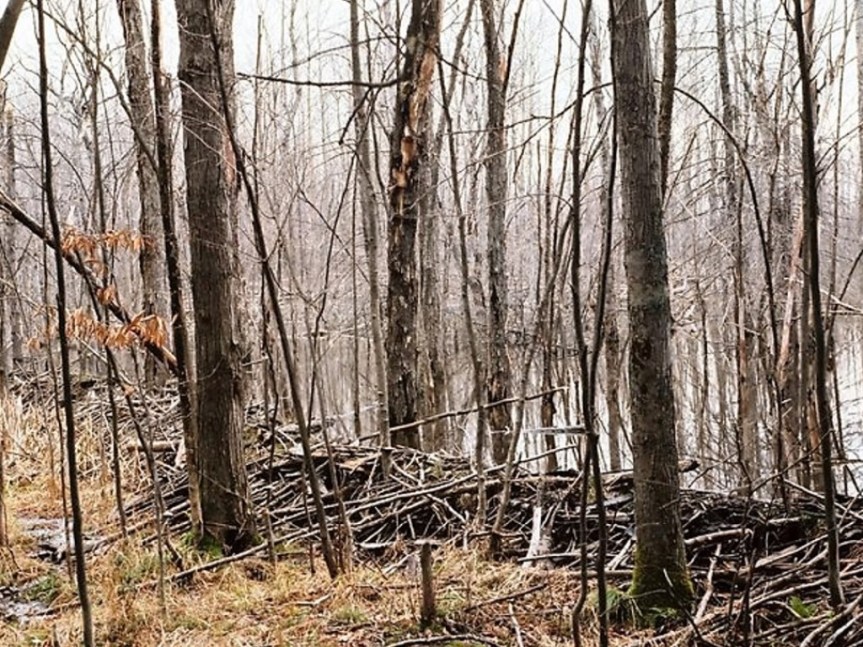
It began the year before, in 1988. Black bear weren’t common sights around my neck of the woods, but I caught a glimpse of one while I hiked some swampland and stopped to sketch and photograph a newly formed beaver dam.

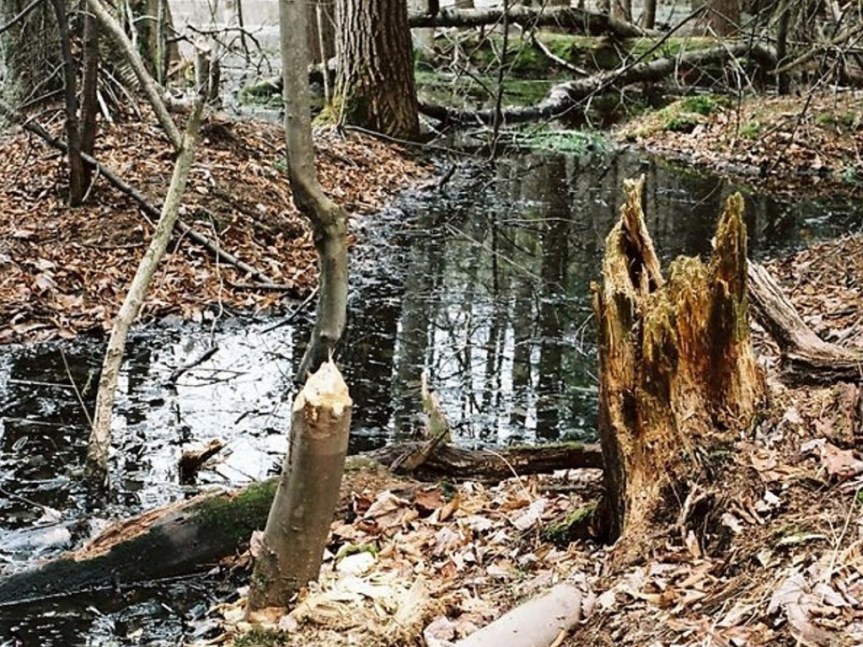
Because swamps make great hiding places, you never know what sort of animals you’ll find in them. But the dam had me engrossed in its quick construction when a big black bear rambled past me. It gave me a wide birth—around 50+ yards between us—but I stayed as still as possible until after it disappeared into the woods. I hadn’t brought a zoom lens for my SLR camera, so I didn’t get any good photos of it.
The image of the bear stayed with me on every outing into the woods and swamps, but we never crossed paths and I never saw any more bear until 30 years later when a black bear peered at me through a ground floor window. I live in a town where the only wild animals brave enough to venture from the woods and into backyards are whitetail deer and a few foxes. The cartoonist in me found the Peeping Tom bear humorous. I imagined a one-panel gag comic strip (like Far Side) where a person comes home to a bear sitting in their La-Z-Boy, reading the newspaper. The bear glances over his reading glasses at the person and says “Hey, how was your day?”
And you just know Mama and Baby Bear are eating porridge in the kitchen!
Anyway, back in 1988, I knew I wanted to paint a black bear, so I visited a zoo and left with plenty of sketches. By the time winter came and the calendar changed to 1989, I had my photos and sketches out and a nice landscape of a swamp and beaver dam in progress.
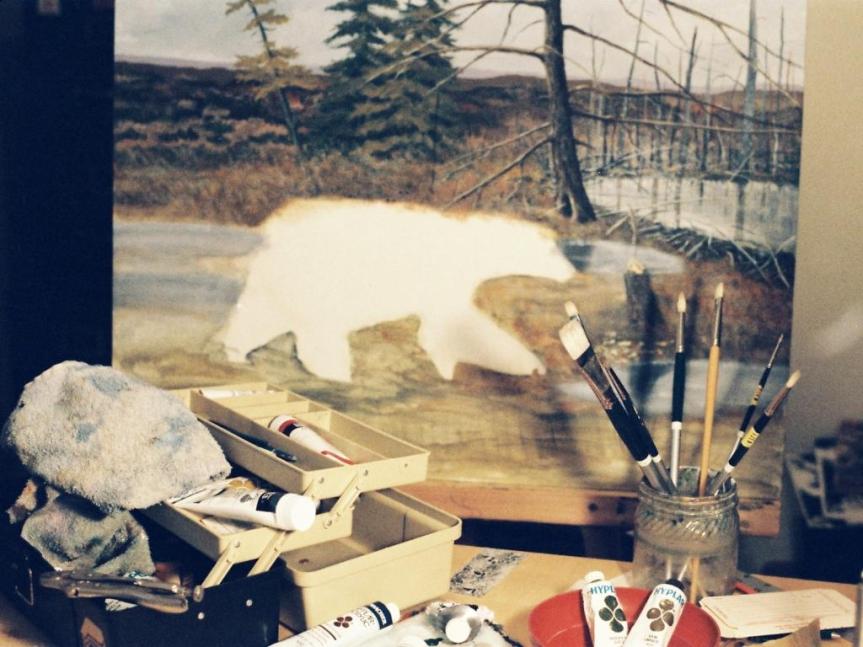
Here is a closeup of the painting, showing detail:

Once I have a painting near completion, I set it aside for a few weeks, much like I do with the books that I write. This way, I return with a fresh perspective.
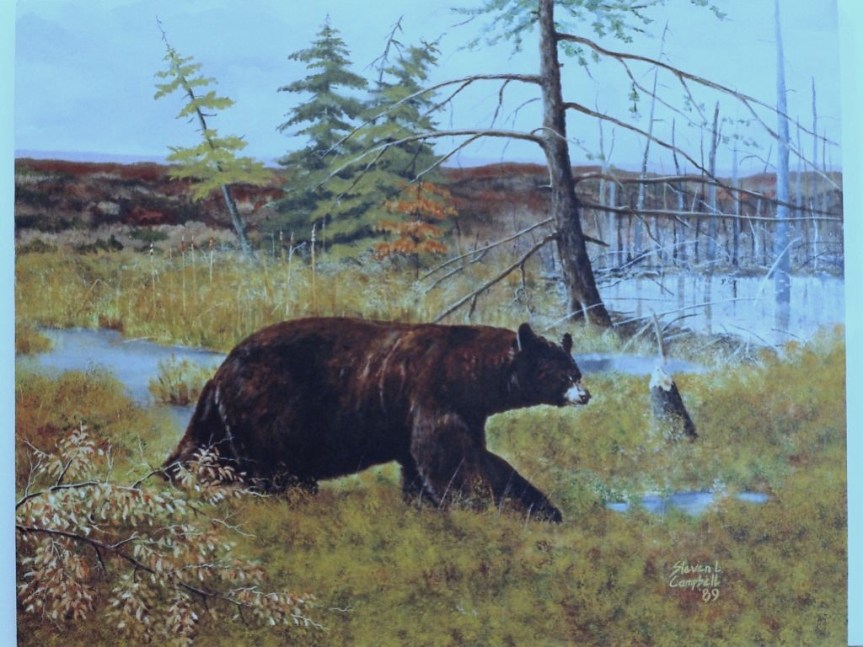
Although the painting looks nice, it’s far from done. Aside from the halo around the bear, I needed to punch up the detail with lots of dark colors. Two nice features of acrylic paints for me are its quick drying time and it allows me to paint from light to dark (similar to watercolor painting), unlike oil paints where one must work their way to the lightest, brightest colors last (known as fat over lean).
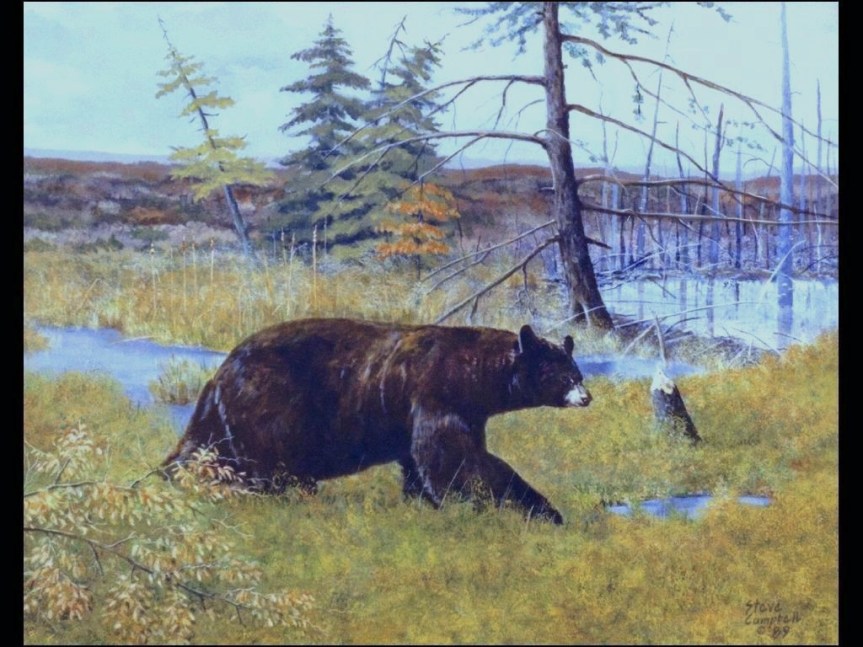
As with oil paints, you can glaze with acrylics. I glazed Ultramarine Blue in areas to create atmospheric depth in the landscape, then punched up the foreground with yellow. Finally, I changed my signature and its placement. Here is the finished painting framed and hanging at a gallery show, April 1990 just before I sold it.
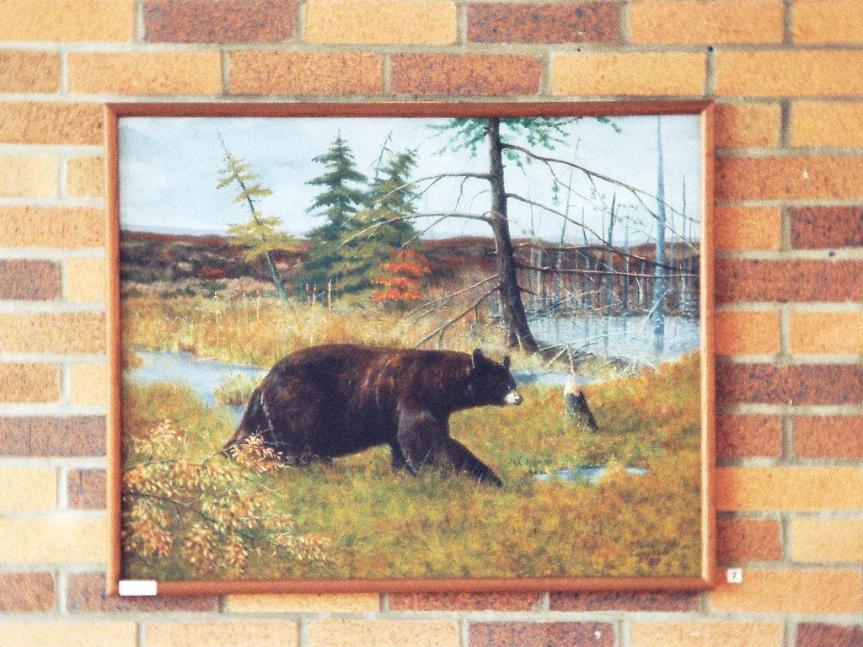
Imagine if I’d never seen that black bear when I was at the beaver dam, I likely would have never painted the painting you see here.
Before I go, I want to share two AI images of black bear art. AI has been a buzzword for many years. Personally, it goes back to the 1980s when I developed an interest in computers. Like all technology, it has advanced considerably, and every year or so I peek at its advancements. Much of my curiosity has been from a writer’s viewpoint, but recently, I took interest in it from an artist’s perspective and wondered how it fared artistically. So, I asked an AI program to give me four paintings of black bear. Here are two of its artificial works:
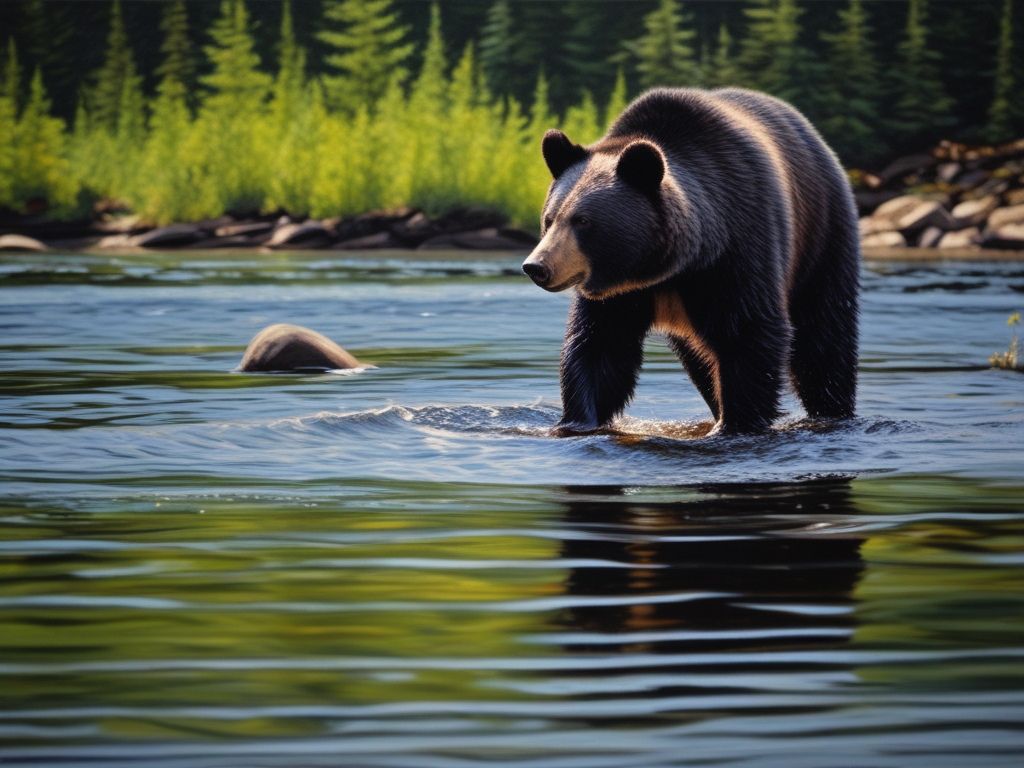
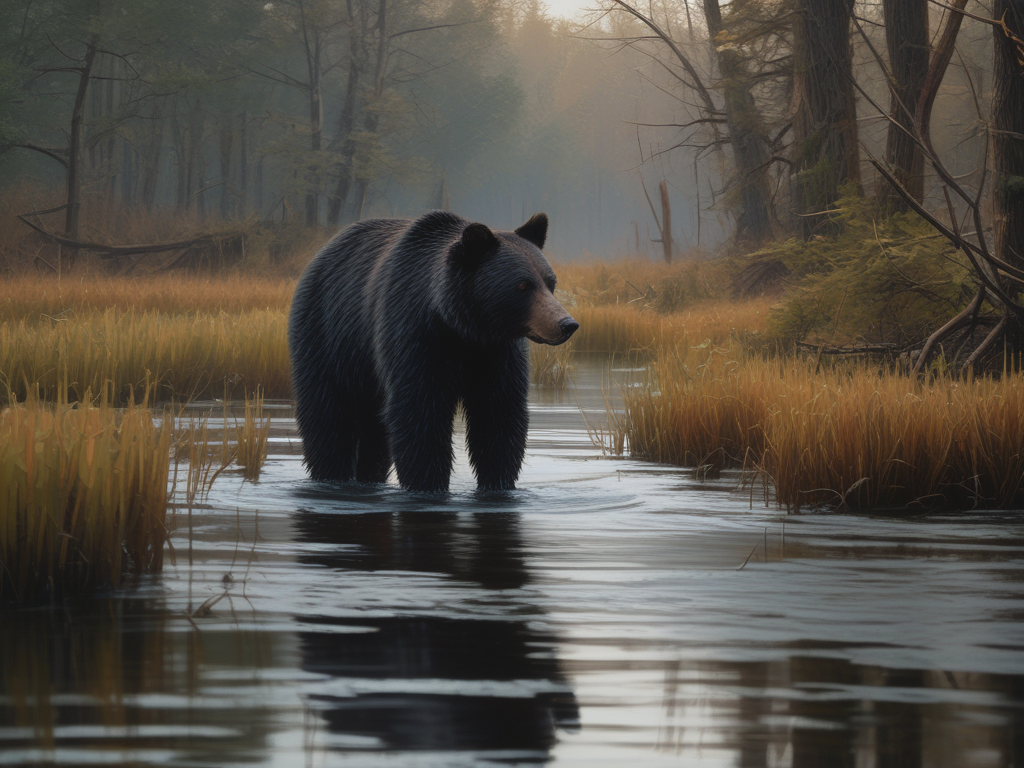
The results are impressive. As an artist, I wonder how this tool can be useful for the human illustrator working on a project? I mean, since AI is the art’s creator, who gets paid for the art? Or is the human illustrators’ role obsolete in the art publishing world?
That’s all for now.
Steve, 7/6/2024
This post “2012.9.26 Art: Evolution of a Painting” copyright © 2024 Steven Leo Campbell at stevecampbellcreations.com – All rights reserved.


Wow to see a bear in the wild is amazing. We don’t have such creatures here in Britain now. (In Zoos only)
Ai is brilliant for us artists. Yes, I know that might not be the right thing to say. I have found it helpful to see if the idea in my head can be created. The fact you have to choose your words carefully when asking AI to create the image makes the image it creates personal to you. AI gave me several different options. The painting I created from its suggestions is completely my own. It’s just the same as using references.i.e. From magazines, books, photos etc.
LikeLiked by 2 people
Northwestern Pennsylvania (where I live) has a large population of black bear, especially around the Allegheny River region. There’s currently a large one roaming the streets of the town I live in. Sightings increase in the fall when they forage for food before winter comes. Luckily, there have been no attacks during the 40-plus years I’ve lived here.
As for AI, I see the tool possibly helping me to “paint” scenes, such as important rooms or other places in my stories, thereby giving me visuals to look at when I return to those places in later drafts (which can be a year or more). I’ve done my own drawings in the past (which I call maps), but AI is quicker and therefore a definite timesaver. I may also use it to “flesh out” my characters, and then keep them in a series bible like the one I created for my Ridgewood stories. And, as you mentioned about painting, it may be useful in garnering ideas for my book covers. The possibilities are exciting to think about!
LikeLike
Although I’ve hiked a lot in West Virginia, I saw a black bear for the first time this summer!!! Wow!! I don’t think human illustrators will be obsolete. The cover of my latest mystery was created through AI, but my cover designer had to create element of the picture separately, then layer them together, then make it look cohesive. Before she did that, she sent me a cover that had not had human intervention. The program had generated elements that didn’t make sense. Like a flag without a flag pole or building on a small town street that wasn’t complete.
LikeLiked by 1 person
My mom’s family lived mostly in the mountains of West Virginia and Maryland, and it was at my great-grandmother’s house that I saw my first black bear … dead. I was five and a country kid, so I understood about hunting for food, but it was the first time I ever saw anyone harvest their kill. She not only had meat, but she also had fat to cook with and to use as lamp fuel, bones as tools, and hide for blankets. Going to her house was always an education in survival.
I know what you mean about AI leaving out elements or generating ones that don’t make sense. That’s why I was surprised to see how well it did with the black bears. It’s still horrible at depicting realistic human hands and eyes, however, so until it improves in those areas, at least, the human illustrator will have a job.
As one who makes his own book covers, I like your idea of using AI as a tool to generate book covers. Perhaps I could use it to depict scenes of my stories for my covers. Then I could take the strongest elements from the scenes and create a powerful cover. Or so I think. Time will tell.
LikeLike