
Not that I never tried to become a published author in the traditional sense, but I’m too impatient to wait for something I can do myself. After all, I self-published my first short story in book form when I was fourteen. Ten years later, I self-published my own comic book. By the time I was forty-four, I’d self-published more than twenty of my books in between juggling my art career and raising my family.
Writing stories is fun and sometimes easy to do. Editing, not as much. Self-publishing, however, is long, hard, tiresome, and daunting work. There is no uncomplicated way to do it all and produce a topnotch product. Even authoring a short story can take several months to produce. My hat is off to those authors who do it all and make it look easy. I strive to be one of them someday.
Meanwhile, I’m still working on getting the next Ridgewood Chronicles book onto the bookshelves at Amazon. It’s a fun series to work on, and I’ve been busy hammering out the next book like a grinning madman to get it finished and onto Amazon’s bookshelves. Like I said, self-publishing is a long, hard road to travel. But when it’s done, I can say I did it my way, no matter the struggles and setbacks that occurred and the tiny errors that made it into the final product.
No one’s perfect, but I must admit my art and design for the covers have improved, even in simplicity.
Before I get back to working on my story, I want to share a bit of advice on taking advice from beta readers and other writers. When I’m writing a story—even if it’s in its fifth draft (if I go that far), I share it with no one. I don’t want anyone’s opinion about all the plot holes and problems in it until I’m done and satisfied that I’ve given my story all I can. Then I hand it over to be critiqued. And sometimes, I ignore some, if not most, of the advice I get. Not to be stubborn or presumptuous, but sometimes I trust my own feelings over those of others, especially if changes are going to topple the plot’s structure like a house of cards.
The biggest plot-toppling changes are usually suggested by writers and readers who don’t understand the enormity of fiction. In the type of fiction I write, anything goes. It isn’t realistic (despite the realistic elements in it) and it’s not meant to be. James Patterson said it well: “I don’t do realism. Sometimes people will mention that something I’ve written doesn’t seem realistic and I always picture them looking at a Chagall and thinking the same thing. You can say, ‘I don’t like what you do, or I don’t like Chagall, or I don’t like Picasso’ but saying that these things are not realistic is irrelevant.”
Another critique problem I have is someone pointing out unfinished clauses and sentence fragments in my stories. Fantasy fiction is full of both. Sometimes those authors even use a preposition to end a sentence with. And so do I.
One last bit of cautionary advice (if you’ve kept with me) is: I don’t let anyone change my story with silly rules. If you’re a writer of fiction, you’ll recognize this one: Eliminate all those adverbs and adjectives!
Really? All of them?
I think not.
Same with deleting every example of that nasty word “was” and not using the word “said” so much. I try to do the latter, but I don’t freak when I see it used in a paragraph that immediately followed a paragraph that already used it.
Rules make sense to a point. It’s up to the author to figure out which ones work best for them.
That’s all for now.
Thanks for reading.
As always, peace and love to all my readers.
Steve, 1/23/2023
This post “Being a Self-Published Author” copyright © 2023 Steven Leo Campbell at stevecampbellcreations.com – All rights reserved.
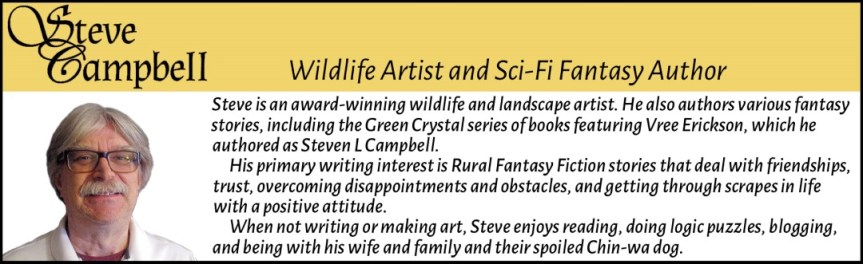
 Steve Campbell Creations
Good luck Steve on getting your books in Amazon. Being a published writer is about as hard as being a rock star.
LikeLiked by 1 person
That’s so very true Max. I still find great books by authors I’ve never heard of, who have a small following, just as you find great music by lesser known artists. They aren’t stars in the business, but they should have been. And on the flipside, some stars shouldn’t have been. The finger of fate is forever fickle.
LikeLiked by 1 person
It’s all about luck and timing…and I’m not saying some talent isn’t there…but you know what I mean.
LikeLiked by 1 person
I agree and know exactly what you mean.
LikeLiked by 1 person
Yeah, the rules thing really depends, so I never follow them either. Especially the adjective bit. Even the guy who hates them the most (Stephen King) uses quite a few adjectives himself. Anyhoo, wishing you all the best on your writing journey!
LikeLiked by 1 person
Thank you for your reply. I have two copies of King’s classic On Writing (the second has contributions from his sons), and I noticed that he isn’t a firm follower of some of his advice. And neither are his sons. Wishing you the best, too.
LikeLike